Running
Feb 02, 2026
T. S. Thakuri speaks about Nepal’s running movement from the top of the world,
By DEJAN NIKOLIĆ
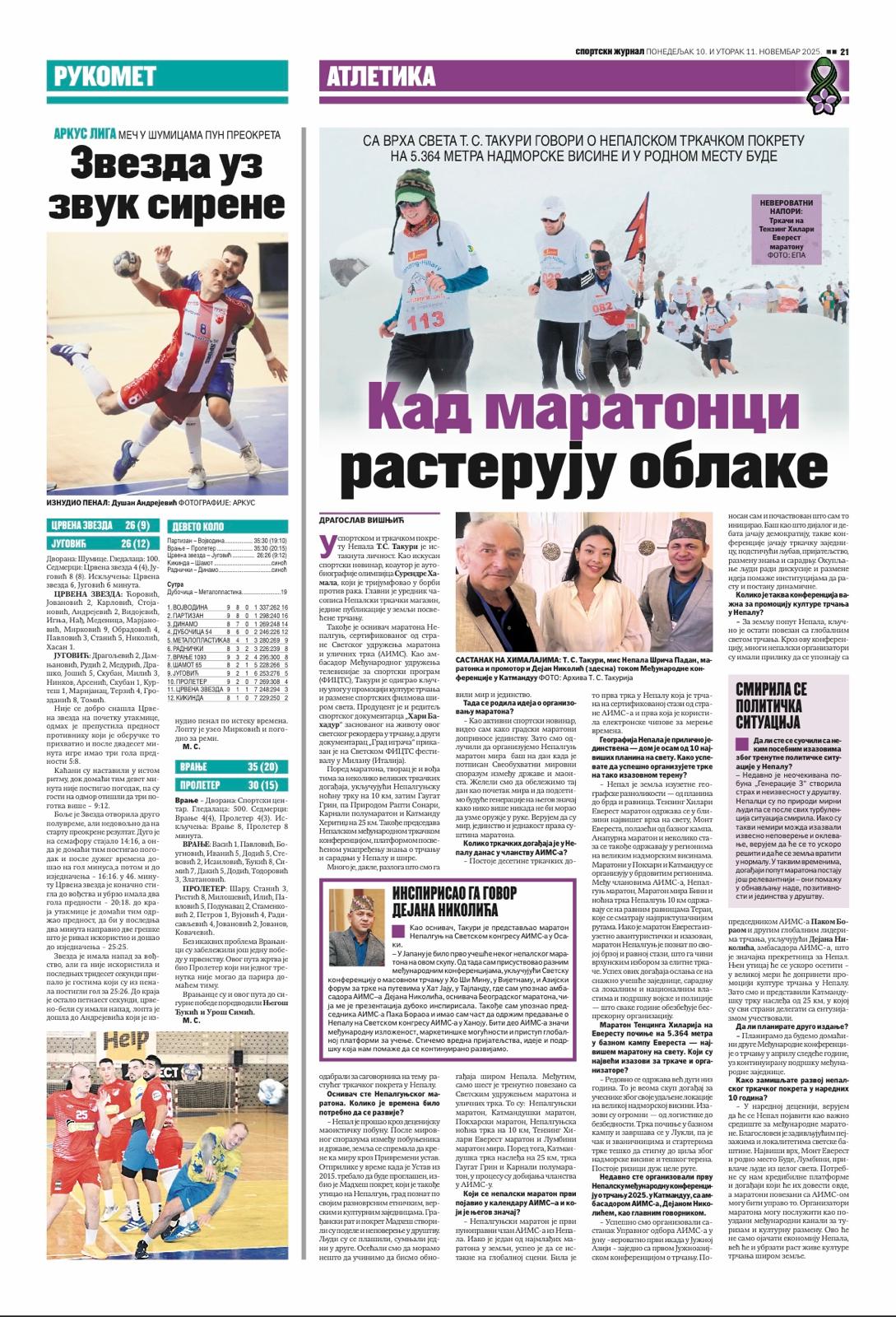
In this conversation, sports journalist Dragoslav Višnjić talks with T.S Thakuri about his journey, vision, and contributions to Nepal’s growing running movement.
https://zurnal.politika.rs/scc/clanak/230111/miks/atletika/kad-maratonci-rasteruju-oblake
T.S Thakuri is a prominent figure in Nepal’s sports and running movement. A seasoned sports journalist, he is the co-writer of the autobiography of Olympian Surendra Hamal, who courageously fought and triumphed over cancer. Thakuri serves as the Managing Editor of Nepal Running Magazine, the country’s only publication dedicated to the sport of running.
He is also the founder of the Nepalgunj Marathon, one of Nepal’s most respected AIMS-certified races. As an AIMS Ambassador and FICTS Ambassador, Thakuri has played a key role in promoting running culture and sports film exchange globally. He is producer & director of Sports related documentary 'Hari Bahadur' based on the life of world record–holding runner Hari Bahadur Rokaya, and another documentary 'Player's City' was screened at the World FICTS Festival in Milan, Italy.
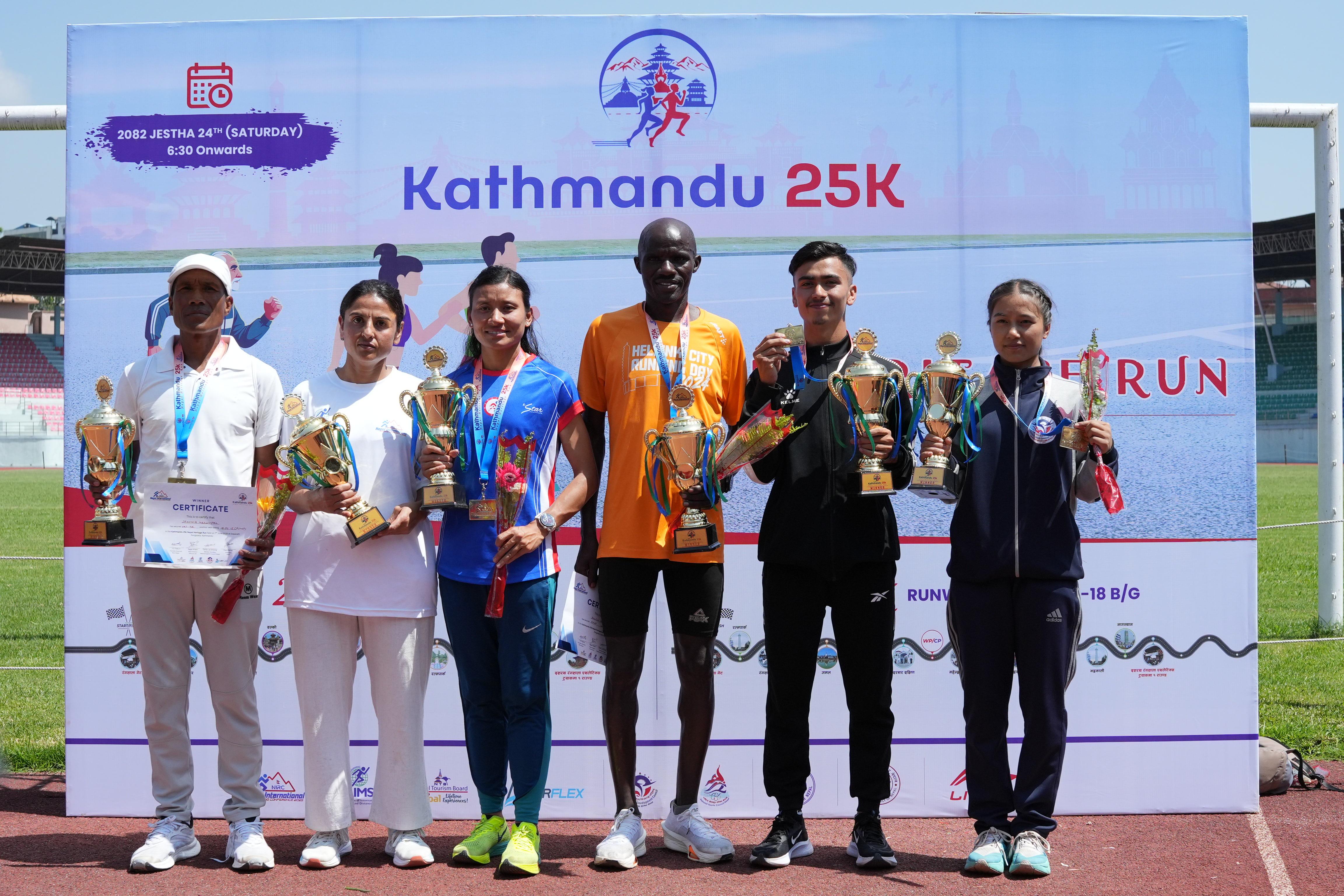
Beyond the marathon, he is the concept creator & Team Leader of several major running events including the Nepalgunj 10K Night Run, Gaughat Green Run, Rapti Sonari Nature Run, Karnali Half Marathon, and Kathmandu 25K Heritage Race. He also chairs the Nepal International Running Conference, a platform dedicated to advancing running knowledge and collaboration in Nepal and beyond.
In this conversation, sports journalist Dragoslav Višnjić talks with T.S Thakuri about his journey, vision, and contributions to Nepal’s growing running movement.
Q: You are the founder of the Nepalgunj Marathon. How long did it take to develop it?
Nepal went through a decade-long Maoist insurgency. After the peace agreement between the rebels and the state, the country prepared to move toward peace through the Interim Constitution. Around the time when the 2015 Constitution was about to be promulgated, the Madhesh Movement erupted, which also affected Nepalgunj — a city known for its diverse ethnic, religious, and cultural communities.
The civil war and the Madhesh movement had both created divisions and distrust in society. People seemed to fear and doubt each other. We felt we had to do something to restore peace and unity. That’s when the idea of organizing a marathon came.
As an active sports journalist, I had seen how city marathons contributed to urban branding and unity. We then decided to organize the Nepalgunj Peace Marathon on Mangsir 5 — the very day the Comprehensive Peace Agreement was signed between the state and the Maoists. We wanted to commemorate that day as the beginning of peace and to remind future generations of its importance — so that no one would ever have to take up arms again.
I believe that peace, unity, and equality are the true essence of a marathon.
Q: How many marathons or running events in Nepal are members of AIMS, and which ones are they?
There are dozens of running events across Nepal. However, only six are currently affiliated with the Association of International Marathons and Distance Races (AIMS):
- Nepalgunj Marathon
- Kathmandu Marathon
- Pokhara Marathon
- Nepalgunj 10K Night Run
- Tenzing Hillary Everest Marathon
- Lumbini Peace Marathon
Additionally, Kathmandu 25K Heritage Race, Gaughat Green Run, and Karnali Half Marathon are in the process of obtaining AIMS membership soon.
Q: As an AIMS member, which Nepali marathon appears first in the AIMS calendar, and what is its significance?
The Nepalgunj Marathon is the first full AIMS member from Nepal. Although one of the youngest marathons in the country, it has managed to stand out on the global stage.
It was the first race in Nepal to be run on an AIMS-certified course and the first to use electronic timing chips. The Nepalgunj Marathon was also the first from Nepal to appear on the official AIMS calendar.
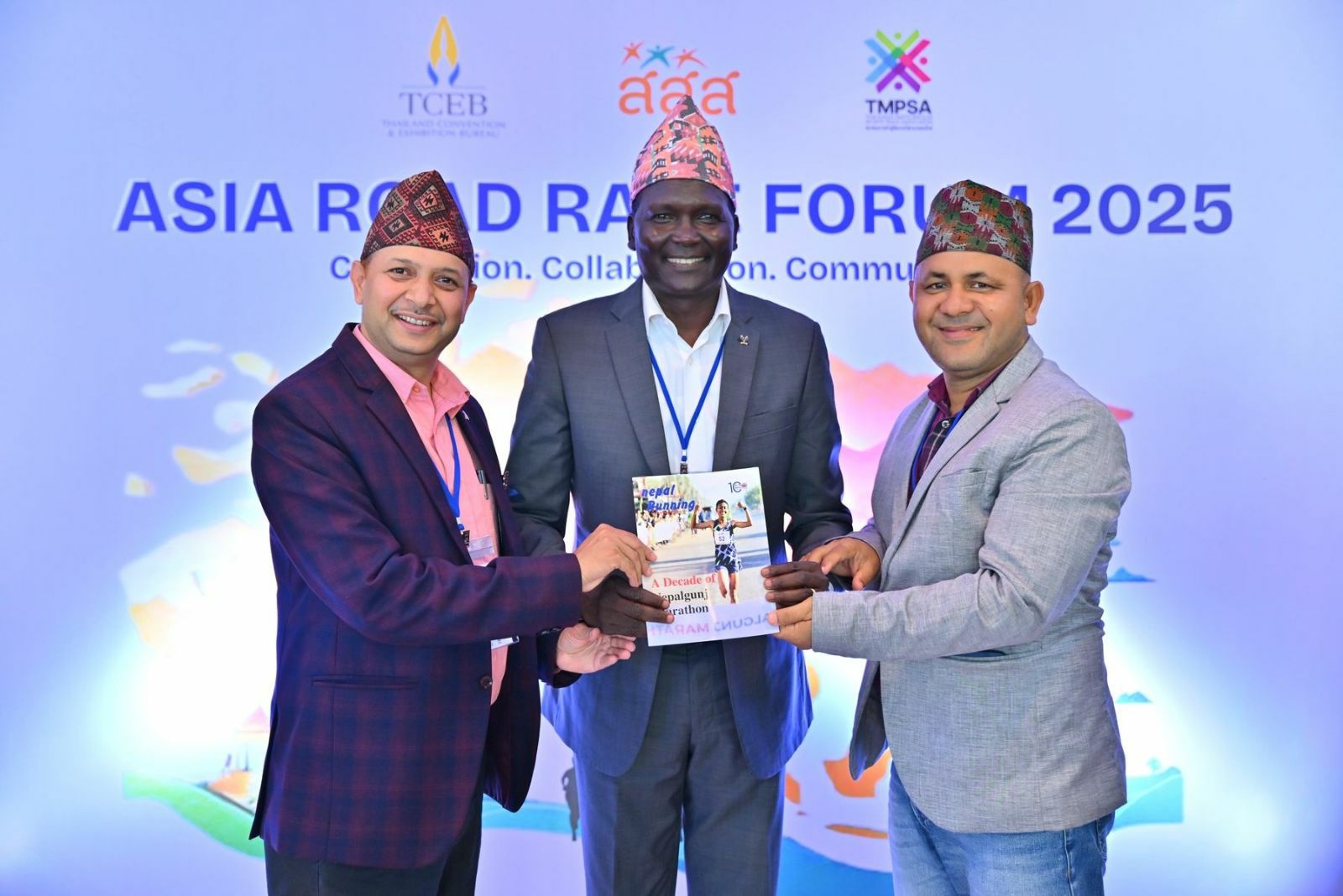
As founder, I represented Nepalgunj Marathon at the AIMS World Congress in Osaka, Japan — the first-ever participation by a Nepali marathon. I have since attended various international conferences, including the Mass Participation World Conference in Ho Chi Minh City, Vietnam, and the Asia Road Race Forum in Hat Yai, Thailand, where I met Dejan Nikolić, founder of the Belgrade Marathon, whose presentation deeply inspired me.
I also met AIMS President Paco Borao and had the honor of presenting about Nepal at the AIMS World Congress in Hanoi.
Being part of AIMS means international exposure, marketing opportunities, and access to a global learning platform. We gain valuable friendships, ideas, and support that help us grow continuously.
Q: Nepal’s geography is quite unique — home to 8 of the world’s 10 highest mountains. How do you manage to successfully organize races in such challenging terrain?
Nepal is a country of extreme geographical diversity — from mountains to hills to plains.
- The Tenzing Hillary Everest Marathon takes place near the world’s highest peak, Mount Everest, starting from the base camp.
- The Annapurna Marathon and several trail races are also held in high-altitude regions.
- The Pokhara and Kathmandu Marathons are organized in the hilly regions.
Among AIMS members, Nepalgunj Marathon, Lumbini Peace Marathon, and Nepalgunj 10K Night Run are held in the flat Terai plains, which are considered the most accessible routes.
While the Everest Marathon is extremely adventurous and challenging, Nepalgunj Marathon is known for its fast and smooth course, making it a top choice for elite runners.
The success of these events relies on strong community involvement, collaboration with local and national authorities, and support from the army and police — which ensures smooth organization every year.
Q: The Tenzing Hillary Everest Marathon starts at 5,364 meters at Everest Base Camp — the highest marathon in the world. What are the biggest challenges for runners and organizers?
It has been held regularly for many years now. It’s a very expensive event for participants because of its remote, high-altitude location. The challenges are immense — from logistics to safety.
The race starts at the Base Camp and finishes in Lukla, and even officials and race starters find it hard to reach the finish line due to altitude and difficult terrain. There are risks all along the route.
Q: You recently organized the first Nepal International Running Conference 2025 in Kathmandu, with AIMS Ambassador Mr. Dejan Nikolić as the keynote speaker. Do you plan for a second edition, and how important is such a conference for promoting running culture in Nepal?
We successfully hosted the AIMS Board Meeting in June — likely the first-ever in South Asia — along with the first South Asian Running Conference. I feel proud and honored to have led that initiative.
Just as dialogue and debate strengthen democracy, such conferences strengthen the running community — fostering love, friendship, knowledge sharing, and cooperation. Bringing people together to discuss and exchange ideas helps institutions grow and become dynamic.
For a country like Nepal, it’s crucial to stay connected with the global running world. Through this conference, many Nepali organizers got to meet AIMS President Paco Borao and other global running leaders, including Dejan Nikolić — a significant milestone for Nepal.
Its impact will be felt soon: it will contribute greatly to promoting running culture in Nepal.
That’s also why we introduced the Kathmandu 25K Heritage Race, in which all foreign delegates participated enthusiastically.
We’re planning to host the second International Running Conference in April next year, with continued support from the international community.
Q: Have you faced any particular challenges due to the current political situation in Nepal?
Recently, the unexpected “Gen Z” rebellion created fear and uncertainty in society. Nepalis by nature are peaceful people — after all the turbulence, things have calmed down now.
Although such unrest may have caused some mistrust and hesitation, I believe it will soon be resolved, and the country will return to normalcy. In such times, events like marathons become even more relevant — they help restore hope, positivity, and unity in society.
Q: How do you envision Nepal’s running movement developing over the next ten years?
In the next decade, I believe Nepal will emerge as an important hub for international marathons.
Nepal is naturally blessed — with breathtaking landscapes and world heritage sites. The highest peak, Mount Everest, and the birthplace of Lord Buddha, Lumbini, attract people from all over the world.
What we need are credible platforms and events to bring them here — and AIMS-affiliated marathons can be exactly that. Marathon organizers can serve as reliable international channels for tourism and cultural exchange.
This will not only strengthen Nepal’s economy but also accelerate the growth of a vibrant running culture across the country.
https://zurnal.politika.rs/scc/clanak/230111/miks/atletika/kad-maratonci-rasteruju-oblake